
• Mashup Religion
  • Jonymac Studio
  • The West End Rhythm Kings

Otherwise Thinking

~ a blog by John McClure

Otherwise Thinking

Category Archives: Musings

Portable Preaching

03 Monday Sep 2012

Posted by John McClure in Musings, Views from the Street

≈ 3 Comments

Tags

application, Christianity, Church, focus statement, Fred Craddock, function statement, homiletics, Lucy Rose, preaching, Religion, sermon, Spirituality, Thomas G. Long

John Henry Newman

John Henry Newman, in his essay “University Preaching” said the following:

Talent, logic, learning, words, manner, voice, action, all are required for the perfection of a preacher; but ‘one thing is necessary,’ – an intense perception and appreciation of the end for which (the preacher) preaches, and that is, to be the minister of some definite spiritual good to those who hear…. (bold-face and parenthetical change added, as quoted by John Broadus in his Treatise on the Preparation and Delivery of Sermons, 255).

In homiletics textbooks, this idea that sermons should have a “definite spiritual end” is normally labelled the “sermon application.” And in homiletics classrooms, teachers of preaching such as myself often speak about this as the business of making sermons “portable,” giving listeners something that is not only memorable, but motivational – that leads to specific actions, behavior, or to a new persuasion. Application also refers to “bringing home” an idea. Portability means that the message “comes to roost” – – it suddenly becomes about us, in this room, in this local situation and can be taken away with us into our daily lives.

I find Newman’s words helpful – urging us to offer some “definite spiritual good” to the listener. “Definite” means unambiguous, clearly stated, and decided beforehand by the preacher. “Spiritual good” implies that the sermon influences the human spirit in some way for the better.

In a similar fashion, Thomas G. Long, in his much-used basic preaching text The Witness of Preaching encourages preachers to jot down both a “focus statement” and a “function statement” before crafting a sermon. The focus statement summarizes the preacher’s message. The function statement summarizes the preacher’s desired result. For Long, this result should be tethered as closely as possible to the literary or rhetorical thrust of the biblical text preached. He wants us to ask first of all: “What do the words of the biblical text want us to do or become as a result of this sermon? Texts don’t just “mean” things, they try to do things!

At least three aspects of this way of thinking are much debated.

1. Should the preacher always decide beforehand what spiritual good is to be brought home at the sermon’s end? Inductive homiletics, under the tutelage of Fred Craddock, questions this presupposition. Instead of moving from the exposition of a general truth to its “application,” the inductive sermon moves through a range of experiences toward a general truth. In many inductive sermons, the listener is left to complete the picture – drawing conclusions that best fit their own faith experience.
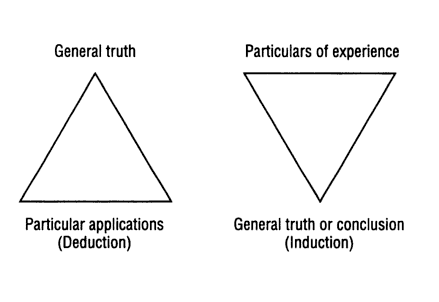
Craddock’s picture of “Inductive logic” (from As One Without Authority)

2. The persuasive element in application-oriented preaching is sometimes called into question. Lucy Rose, in her book Sharing the Word: Preaching in the Roundtable Church, argues that this persuasive and transmissive model of communication is non-dialogical and reinforces a gap between pulpit and pew. It makes the goal of preaching the business of transmitting what the preacher wants to happen into the hearts and minds of rather passive listeners. This tends to disempower listeners – even if and when they nod and articulate their consent, as in call-and-response forms of preaching. In effect, listeners learn to be passive – awaiting the portable golden nugget(s) to arrive each week.
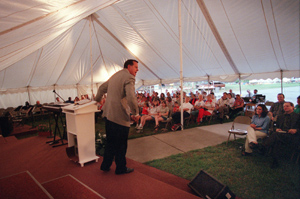
3. Others believe that “applications,” especially when they are too specific, let some people off the hook. If the preacher is too precise in spelling out a particular “pay-off”, people may find wiggle room enough to say, in effect: “That’s not about me.”

Despite these concerns, when interviewed about preaching, sermon listeners indicate that they generally listen for some kind of portable “take home” element in sermons. The Listening to Listeners to Sermons Project, a massive empirical project funded by the Lilly Foundation, contained several findings that point directly to the desire among listeners for some kind of “portable” application in sermons. Three of these, summarized by Ronald J. Allen, who spearheaded this project, point toward sermon portability:

  • The sermon should center in the Bible and make the biblical material come alive for the listener
  • The message needs to relate in a practical way to the lives of the listening communities
  • Congregations are eager for sermons to help them make theological and ethical sense of the range of life‘s issues
  • Ministers ought to be specific in helping congregations draw out the implications of the Bible and their deepest theological convictions

I sometimes draw out the distinction between denotative “applications” of the gospel, and the connotative “implications” of the gospel. This idea is not new. The great mid-twentieth-century homiletician H. Grady Davis, in his book Design for Preaching put it this way:

“…a sermon idea of more than a bare thought. It is a thought plus its overtones and its groundswell of implication and urgency.”

Whereas an application might denote a particular sought-after behavior or attitude, an implication is not always explicitly stated. Implications surround us with images, ideas, questions, angles of vision that “implicate” us in some way. Instead of striking directly, like an arrow, implications absorb us into a sphere of gospel-influence.

Implications should not be wishy washy. They can and should be intentionally pursued by the preacher. They can be honed as carefully sought “spiritual goods” within sermons, and might include such things as being implicated in the gospel’s relentless hope, or its ethical challenge, or its unexpected offer of forgiveness. Preachers still have to decide ahead of time what such implications are, but they do not have to turn them into a highly specific sermon-takaway (or a list of such things).

In the end, it is likely that all sermons have some kind of function (even if it is to put the listener to sleep). Finding that function, whether an “application” or an “implication”, truing it up, refining it, and focusing it on the situation of one’s listeners can be crucial for making a sermon portable in the best sense of the word.
Keeping the “Prayers of the People” a Prayer

15 Sunday Jul 2012

Posted by John McClure in Musings

≈ 2 Comments

Tags

crafting liturgical prayer, intercession, liturgical prayer, prayers in worship, prayers of the people, praying in public, praying in worship, presiding at prayer, public prayer

Keeping the “Prayers of the People” a prayer

Intercession is sometimes offered with the pastor or priest asking openly for prayer concerns, attempting to gather them into a prayer on the spot. This practice is often a wonderful experience of community prayer. In my experience, two problems typically accompany this form of prayer:

  1. People can’t hear. This is an issue of hospitality. As presiders we are in control of worship – and controlling the microphone is a crucial way in which we either welcome everyone, or exclude many. In many instances, only those near the person lifting up a prayer concern or thanksgiving will actually hear what is said.
  2. People cease to pray. The “Prayers of the People” becomes “announcement time,” or a time when the congregation is not at prayer but simply sharing concerns, as they might in a small devotional group.

It is possible, however, for the us as leaders to use a form that will permit every prayer concern to be audible by all, and enable the congregation to remain in a state of prayer from start to finish.

Here’s what I suggest:

1. Invite the congregation into prayer, asking for prayers to be offered “on microphone only.”

2. While the congregation remains in prayer, you, as pastor, or someone designated by you, move among the congregation (with a hand-held microphone if possible) and stand at a particular pew or row of chairs and receive both the person’s name and brief prayer of intercession.

3. Before moving on, you repeat in a short sentence form a bidding prayer,  (“Let us pray for”…) followed by a category of prayer (“healing and comfort”) followed by the specific object of the congregation’s intercession not going again into detail (” for Jim Smith’s mother, Mary), followed by an invitation for response in an attitude of prayer (“Lord in Your mercy”)

Full example: Let us pray for healing and comfort, for Jim Smith’s mother Susan. Lord in your Mercy:

4. Followed by a congregational response: “Hear our Prayer.”

5. Then move to the next person with a petition or prayer.

This process can then be concluded with a collect.

The entire process is done in an attitude of prayer. 1) We hear the prayer, 2) we rephrase the kind of prayer offered, 3) we ask for the congregation’s prayer, 4) they respond with prayer.

Again, my hope is that:

  1. Everyone can hear.
  2. Everyone will be at prayer.

Seems simple. But it takes some thought and planning in each of our situations to make it happen.

Preaching the Good News as GOOD News

30 Saturday Jun 2012

Posted by John McClure in Musings

≈ 8 Comments

Tags

anger, Good News, Gospel, imperatives, John S. McClure, motives, nagging, positive preaching, preacher, preaching, preachy, sermon

Preaching the Good News…

Image …as Good News

For a variety of reasons, we often fail to communicate any motivating “good news” in our sermons. From my experience, there are several reasons for this.

Sometimes we cave in to the culture’s pejorative definition of “preach” – thus the need to sound “preachy.” We load sermons with hard or soft imperatives: “we must,” “we should,” or “let us,” and “we are called to….” When this happens, I am reminded of the hospital nurse, using the “nurse’s ‘we’”: “we need to take our medicine now,” “let’s sit up now and eat some lunch.”

At other times, we worry that the congregation is not doing all that it could do to support our exciting vision for church growth or social justice. We feel compelled to nag at our congregations for their failings.

At other times, we lose sight of the redemptive good news altogether. We are lost in doubt, lack of theological confidence or conviction, and can only muster a few “hints and helps for daily living” as a positive message on Sunday morning.

In the worst case scenario, we allow ourselves to become angry with something in the congregation or culture at large. We feel the need to “load up on people” week after week, dividing the sheep from the goats.

There is certainly plenty of bad news in this world, and the good news that we preach should not appear pollyannish. With this in mind, I still feel compelled from time to time to remind myself that the heart and soul of preaching is the good news of God’s redemptive grace and mercy. Whether preaching a text from the Hebrew Bible or from the New Testament, we are fundamentally in the service of a God of redemption and hope. With this in mind, I offer these suggestions:

  1. Preach only what inspires you. It is easy to finish several hours of exegesis only to arrive at a completely flat, moralistic, and insignificant message. Ask yourself whether your message is inspirational good news for your own life. Then proceed.
  2. Examine your motives. Be sure that you are not motivated in your preaching by either anger or your church administrative agenda. Are you motivated by the desire to preach a life-changing and world-changing word of grace and hope?
  3. Be sure that the good news you preach is faithful to the biblical text you are preaching. There is not only one good news message in the Bible. God’s grace and mercy take many different shapes. It is not always “personal salvation” or “liberation,” or whatever our doctrinal preference may be. Seek out the richness of God’s redemptive presence in the Bible.
  4. Although there are occasions and biblical texts that call for an imperative word from the pulpit, it is best to avoid both the hard and soft imperative voice in preaching, unless it is first grounded in the solid indicative of God’s grace. Weed out the language of “must,” “should,” “ought to,” “let us,” “we are called to,” and try using the language of identity, possibility, process, and vision. Give the strong impression in every sermon that the church is a powerful agent of grace, living more deeply into its redemptive identity every day.
  5. Regularly rethink your theology as it meets your congregation. Ask yourself: What do I really believe? What is God doing in our midst? Who is Jesus Christ and what is Christ’s good news for our world today?

These simple practices may help us reorient our preaching toward a redemptive purpose so that the good news that we preach on Sunday morning is really good news to our hearers.

Tone of Voice and the Expression of Religious Desire

25 Tuesday Oct 2011

Posted by John McClure in Musings

≈ 3 Comments

Tags

desire for God, geno-song, performance, preaching voice, religious desire, sermon invention, sermon soundscape, sound of the sermon, the grain of the voice, tone of voice, vocal performance, voice

In Mashup Religion: Pop Music and Theological Invention, I argue that in vocal performance, the voice shapes the desire for God that is given expression in, under, and around the actual words spoken.

Popular culture theorist Peter Antelyes, when speaking about the music of Bessie Smith, used the intense closeness of the microphone as a metaphor to describe the graininess of her singing: “Bessie didn’t need a microphone because she was a microphone, or rather, she had swallowed it; and she would fill you up with her own ‘muscle.’”

Semiotician Roland Barthes calls this the “geno-song” which gives expression to the sheer material beauty or voluptuousness of the way the words are “bodied forth,” accentuating the shaping and uttering of sounds apart from their being communicable language in service to codes and conventions of proper speech and communication.

In the book (119-120) I go on the say that:

The grain of the voice invents the tone or tone of voice established by a theological composition. This tone of voice is pervasive and invents the shape of religious desire. … This desire takes many shapes defined by many tones of voice: persuasive, collegial, moralistic, wise, insightful, responsible, anxious, troubled, longing, hopeful, and so on, and contributes to the construction of a soundscape of religious desire that a theologian and audience inhabit and rely on.

The tone or grain of the work is pre- or extra-verbal. It expresses an intention: life lived within this religious soundscape, prior to, or in spite of the content of one’s words. It says such things tacitly as: “welcome to the intimate, exclusive soundscape of the wise mentor who desires for you to learn what she knows,” or “welcome to the loud, nagging soundscape of the angry parent who desires a more obedient child,” or “welcome to the inviting, interpersonal soundscape of persuasion and the desire for your conversion.”

As the sound of religious desire searching for language, the voicing of theology lies at a deeper, more interior level than words or ideas can express. As theologian Burton Cooper puts it: “Our love of God, our trust in God, our felt need of God, our loyalty to God, in other words our emotional relatedness to God, lie at a more fundamental level than our ideas about God.” Even without the words, the grain of the voice expresses a very particular religious intention, creating a soundscape that shapes the form of religious desire that exists between communicator and audience. The final sound of a theological performance, therefore, is a profound expression of religious intentionality, giving voice to the shape of the God-shaped hole between performer and audience as it reaches toward adequate words. When an audience hears the final mix, they tune in to the tone of the work, and hear beyond words the sonic shape that desire for God can take within the larger soundscape of their lives.

From “Air Guitar” to “Air Preaching”

05 Wednesday Oct 2011

Posted by John McClure in Musings

≈ 7 Comments

Tags

Air Guitar, Air Preaching, figures of speech, Fred Craddock, learning to preach, preaching and performance, preaching gestures, rhetoric and preaching, teaching preaching, tropes

From time to time, I’ll be posting items on this blog taken from the blog for my new book, Mashup Religion: Pop Music and Theological Invention.  In the book, I suggest that those who compose theology at the interface between the academy and popular culture, whether creating blogs, engaged in religious education, advocacy, preaching, etc., could learn a great deal from those who make popular music. One element from popular music making that could easily migrate over into performance-based modes of popular theologizing, especially preaching, is the art of “covering” other artists work (riffs, hits, beats, rhythms, etc.), and then “styling” on those tropes until they become one’s own. There are many aspects of the larger process of “covering” the work of others, but one useful aspect is found in what is known as “air guitar.” Air guitar playing is the act of imitating the rhythms, notes, accents, movements, riffs, cadences, and overall style of another guitarist. For the actual guitarist, this is the beginning of the process of “living into” another artists unique style, absorbing much of it, and making it one’s own. Here’s a great short clip of Led Zeppelin guitarist Jimmy Page almost unconsciously engaging in air guitar to a classic riff by guitarist Link Wray.

JIMMY PAGE from “IT MIGHT GET LOUD”


This practice could easily migrate over into the way one learns to preach or compose theology in general. For instance, now that so many sermons are available in recorded form online, it is simple to listen to or watch preachers who are seasoned and have lots of great “riffs,” and then “air preach” their work, embodying gestures, attitudes, or facial expressions (if video is used), but more importantly, learning any number of stylistic “tropes” or figures of speech that could be used in sermons. Here is one I sometimes use in class by the renowned preacher Fred Craddock. Like Link Wray in the video clip above, Craddock’s style represents a now classic genre of preaching sometimes called “inductive preaching,” in which the preacher begins with the particulars of experience and moves slowly toward a large idea. One of Craddock’s favorite tropes for getting listeners on board experientially is to have them imagine a word or category of thought with him. It’s a simple trope, and I sometimes have students listen to him several times, then “air preach” with him, and finally “style on” his work by choosing another word or category (fear, hope, peace, etc.) and developing it in a similar way. Try it out. Here’s the sermon clip containing the trope used by Fred Craddock.

FRED CRADDOCK: SERMON CLIP

← Older posts
Newer posts →

Enter your email address to subscribe to this blog and receive notifications of new posts by email.

Join 194 other subscribers

John McClure

Recent Posts

  • My Sermon Organization Method: Sermon Sequencing and the “Multi-Track Sermon”
  • Transcript: Jeremiah Wright’s 9/11 Sermon
  • Getting Sermon Feedback
  • Sermon Logic in a Hyperlink Generation
  • Multimedia Preaching
  • Humor and Preaching
  • Extemporaneous Preaching and the Art of Improvisation
  • Long-Range Preaching
  • The Frustrated Preacher
  • This Sabbatical: Trying On A Few (Old) Shoes

Categories

  • Connecting the Dots
  • improvisation
  • Musings
  • Views from the Street
  • Who is this?

Archives

  • July 2020
  • September 2016
  • July 2014
  • December 2013
  • August 2013
  • July 2013
  • May 2013
  • April 2013
  • March 2013
  • February 2013
  • January 2013
  • December 2012
  • November 2012
  • October 2012
  • September 2012
  • August 2012
  • July 2012
  • June 2012
  • February 2012
  • January 2012
  • December 2011
  • November 2011
  • October 2011
  • September 2011
  • August 2011
  • July 2011

Buy Speaking Together and With God

Speaking Together and With God: Liturgy and Communicative Ethics

Buy Under the Oak Tree

Under the Oak Tree

Buy Mashup Religion

Buy Otherwise Preaching

Buy Preaching Words

Buy Claiming Theology in the Pulpit

Buy The Four Codes of Preaching

Buy The Roundtable Pulpit

Buy Listening to Listeners: Homiletical Case Studies

Download Telling the Truth: Preaching about Sexual and Domestic Violence (free)

Buy Best Advice for Preaching

Buy New Proclamation: Year C; Advent Through Holy Week

Blogroll

  • I P Prospective
  • Leslie Rodríguez Photography Blog
  • Los Rodriguez Life
  • Mashup Religion
  • Ministry Matters
  • Peer Pressure is Forever
  • Rock and Theology

Websites

  • Academy of Homiletics
  • Captured by Leslie: Leslie Rodriguez Photography
  • Homiletic: A Journal of Religious Speech Communication
  • Otherwise Thinking facebook page

RSS Mashup Religion

  • Sherry Cothran’s “Strange Woman”: Popular Music as Parahomiletic
  • New Blog about Artists in my Recording Studio
  • Para-homiletics and video games
  • From "Air Guitar" to "Air Preaching"
  • Wound 3: The Wounding of “Spatial” Desire
  • II. The Second of Five Wounded Desires: The Wounding of Ethical Desire
  • I. The First of Five Wounds/Five Desires: the Wounding of Our Desire for God
  • Caveats
  • Join me in a theological mashup
  • Musicians Might Learn a Thing or Two from Theologians

Otherwise Thinking

  • RSS - Posts
  • RSS - Comments

Blog at WordPress.com.

  • Subscribe Subscribed
    • Otherwise Thinking
    • Join 194 other subscribers
    • Already have a WordPress.com account? Log in now.
    • Otherwise Thinking
    • Subscribe Subscribed
    • Sign up
    • Log in
    • Report this content
    • View site in Reader
    • Manage subscriptions
    • Collapse this bar
 

Loading Comments...